





The Art of Reading Water: Small Stream Fly Fishing with a Bamboo Rod
Small streams are the heartbeat of fly fishing. Narrow corridors of water threading through alder thickets, pocket water boiling off boulders, a single seam of current holding a fat brown trout — these are the places where fly fishing becomes something close to meditation. And no tool enters that world more naturally than a well-made bamboo fly rod.
In this guide we explore the craft of reading small-stream water, the unique advantages of bamboo in tight quarters, and how to choose the right rod and taper for the water you love most.
Why Small Streams Demand a Different Approach
Most fly fishing instruction focuses on big rivers — long drifts, mending, reading large current seams. Small streams throw all of that out the window. The casts are short (often under 25 feet), the fish are spooky, and your backcast is constantly threatened by bankside vegetation.
Success here depends on three skills:
- Reading micro-habitats — identifying exactly where fish hold in small water
- Accuracy and stealth — getting the fly to the fish before they see you
- Matching the tool to the task — using a rod with enough sensitivity to feel a soft take and enough delicacy to land a size 18 Elk Hair Caddis without a splash
This is where bamboo rods earn their reputation.
The Bamboo Advantage in Small Streams
Slow Action = Soft Presentation
The natural flex of a well-tapered bamboo rod loads slowly and unloads gently. That translates directly into softer turnover — dry flies land without the "thwack" that sends small-stream trout scattering under the bank. Carbon fibre rods optimized for distance casting are, simply put, over-gunned for 20-foot pocket water.
Sensitivity You Can Feel
Bamboo transmits vibration differently than graphite. Many small-stream anglers describe the feel as "connected" — the rod telegraphs every hesitation of the current, every nudge at the fly, before the eye can register it. On streams where fish take and reject a fly in a fraction of a second, this matters enormously.
Appropriate Power for Appropriate Fish
Small-stream trout are not 20-inch slab rainbows. They are 8-inch wild brook trout and 10-inch cutthroats, and they deserve a rod scaled to their fighting weight. A 6.5-foot #3-weight bamboo rod built on a Para 14 or Garrison 201 taper gives these fish the dignity of a proper fight — and gives you the pleasure of feeling every run.
Reading Small-Stream Water: Key Features
1. Pocket Water
Pocket water forms where current breaks around mid-stream boulders, creating a cushion of slack water immediately upstream and a calmer pocket directly downstream. Trout rest in both zones, facing upstream, waiting for insects to funnel into the current lanes on either side of the rock.
Approach: Wade wide, cast at a steep angle upstream. A 15–20 foot cast is usually enough. Aim for the leading edge of the foam line at the pocket's tail.
2. Plunge Pools
Where gradient steepens and water drops over a ledge, it excavates a pool below. The tail of that pool — where water shallows and slows — concentrates rising fish during a hatch. The deep dark heart of the pool holds larger fish that rarely move unless the food supply is exceptional.
Approach: Fish the tail first (nearest fish, lowest risk of spooking the whole pool). Work upstream incrementally. A short, accurate cast with minimal false casting keeps your fly in the water longer and your profile lower.
3. Inside Bends
Current swings to the outside of a bend, scouring deep and fast. The inside bend is shallower, slower, and often filled with fine gravel — prime spawning habitat, and in season, a place where fish stack up in the eddy just behind the point where inside and outside currents converge.
Approach: Approach from downstream on the inside. Cast across to the current seam where inside-bend slack meets the main current. Watch for subtle sips rather than splashy rises.
4. Undercut Banks
Undercut banks are the secret rooms of small streams. Root tangles, submerged logs, and the perpetual shadow of an overhanging bank provide cover that large trout exploit ruthlessly. These fish see few flies because few anglers bother to fish here.
Approach: Kneel or crouch. Cast parallel to the bank with a reach cast that drops your fly a foot or two upstream of the cut, letting it drift naturally under the overhang. This is where a 6.5-foot rod outperforms a 9-foot rod — you can keep more line off the water and out of the overhanging vegetation.
Choosing the Right Bamboo Rod for Small Streams
Rod Length
| Stream Type | Recommended Length | Notes |
|---|---|---|
| Heavily wooded streams | 6'0"–6'6" | Shorter rod for roll casts and sidearm strokes |
| Semi-open meadow streams | 7'0"–7'6" | Extra length helps with mending on longer drifts |
| Open mountain streams | 7'6"–8'0" | Maximum reach, still manageable in pockets |
Line Weight
Small-stream rods typically throw #2, #3, or #4 weight lines. The lighter the weight, the more delicate the presentation — but also the more challenging in wind. A #3 is an excellent all-around choice for streams under 20 feet wide.
Classic Tapers for Small Streams
Paul H. Young Para 14 — Perhaps the most famous small-stream taper in American bamboo history. Its progressive action loads beautifully at short distances and produces uncanny accuracy. ZHUSROD has built several Para 14 replicas for customers fishing Appalachian brookies, and the feedback is unanimous: this rod belongs on small water.
Garrison 201 — A medium-fast action that rewards a smooth casting stroke. Less forgiving than the Para, but with a precision that suits experienced anglers fishing technical small streams.
Orvis Flea — Orvis's classic ultra-light taper for short rods. The Flea (also called the "Midge" in some catalogs) was designed specifically for heavily-wooded streams where casting room is measured in inches. At 6 feet for a #2 weight, it remains one of the most elegant tool-to-task matches in fly fishing history.
Orvis Mitey Mite — Where the Flea pushes toward the absolute minimum, the Orvis Mitey Mite 5ft 3wt bamboo fly rod stakes out a unique middle ground. At just 5 feet and built for a #3 weight line, it is arguably the most compact fishing-capable bamboo rod in the Orvis catalog — compact enough to slip through alder thickets with minimal rod-tip snag, yet with enough backbone to turn over a size 12 Royal Wulff in a gusty mountain canyon. The 2-piece construction keeps the overall pack length practical for backcountry access. For anglers who hike into remote drainages where every inch of casting room counts, the Mitey Mite blank is also available for those who prefer to finish their own rod.
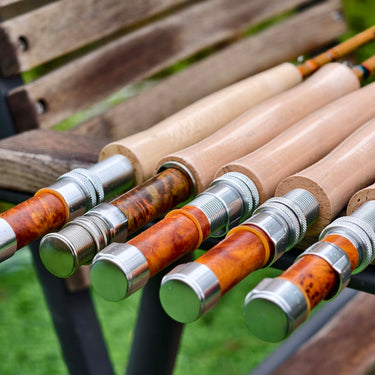
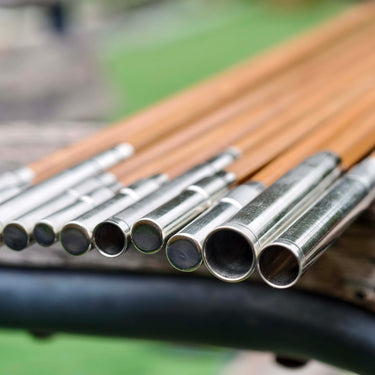
All four tapers are represented in the ZHUSROD taper library. Each rod is built to order from 5-year-aged Phyllostachys bamboo with 18% nickel-silver ferrules, following the original taper dimensions.
Rigging for Small Streams
Leaders
Short leaders — 7 to 9 feet — turn over better with short casts. Consider a furled leader for the ultimate soft presentation: its gentle unrolling action is unmatched when fishing a size 16 Adams to a rising brookie six inches from the bank.
Fly Selection
Small-stream trout are opportunistic and rarely selective. A small box with a few proven patterns covers most situations:
- Elk Hair Caddis (#14–#18) — arguably the single most useful small-stream dry fly
- Royal Wulff (#12–#16) — visible in fast pocket water
- Parachute Adams (#14–#18) — classic, reliable, universal
- Stimulator (#10–#14) — for plunge pools and fast pockets
- Soft Hackle Wet Fly — when fish are feeding subsurface
Tippet
Use fluorocarbon 5X or 6X for most small-stream fishing. In ultra-clear, flat water, drop to 7X. The smaller diameter reduces drag and makes the fly appear more natural.
Stealth and Approach
Reading the water is half the battle. The other half is not being seen.
- Wear drab colors. Bright clothing flashes like a signal mirror above the treeline. Earth tones — olive, tan, grey — help you blend.
- Minimize wading disturbance. Step slowly, avoid grinding gravel, and when possible, cast from the bank.
- Stay low. A silhouette above the skyline is the classic spook trigger. Crouch, kneel, and fish from the side.
- Read the light. Approach with the sun at your back when possible — your shadow falling upstream alerts fish instantly.
The Experience of Fishing Small Water with Bamboo
There is something that happens when you fish a small mountain stream with a bamboo rod that is difficult to articulate to someone who has not done it. The rod bends differently. The casting rhythm slows. You find yourself pausing between presentations, actually watching the water, listening to it.
Part of this is the rod — bamboo's natural cadence asks you to slow down. Part of it is the stream itself, which demands attention: every pocket different, every pool a puzzle. Together they produce an experience that veteran anglers consistently describe as the most satisfying kind of fly fishing there is.
ZHUSROD rods are built for exactly this experience. Founded in 1996, each rod takes approximately two months to complete — because we believe that the time spent making the rod is inseparable from the time you will spend fishing it.
Getting Started
If you are new to small-stream bamboo fishing, a mid-length rod in the 7-foot range with a #3 or #4 weight line is the most forgiving starting point. The Para 14 taper, while classically "advanced," is so smooth and self-correcting that many new bamboo anglers find it easier than stiffer, faster tapers.
Browse our current build list at /collections/bamboo-fly-rods, where you can filter by rod length, line weight, and taper. Every rod ships with a hand-sewn canvas rod bag and comes backed by ZHUSROD's lifetime craftsmanship warranty.
Ready to find your small-stream rod? View the full bamboo fly rod collection →