



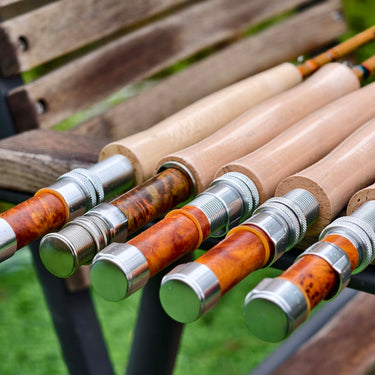




Garrison 212E Bamboo Fly Rod - 8ft 6wt | Power E Series | ZHUSROD
The Man Behind the Math: Everett Garrison
Everett Garrison (1893–1975) was not a professional rod maker in the commercial sense. He was a civil engineer by trade — meticulous, systematic, and deeply skeptical of tradition for its own sake. He applied structural calculations to bamboo rod design at a time when most makers relied on intuition and muscle memory alone.
Between 1930 and the 1970s, Garrison produced fewer than 700 rods in his lifetime, each one a product of his obsessive formula-driven methodology. His system, documented in painstaking detail in A Master's Guide to Building a Bamboo Fly Rod (co-authored posthumously by Hoagy B. Carmichael), calculates stress curves along the entire blank length — treating the rod not as a bent stick, but as a precision cantilever beam.
Garrison tapers carry designations based on a numerical system reflecting length and weight characteristics. The 200-series represents his mature, large-water designs — rods built for rivers wider than most trout fishers ever encounter in their lives.
The 212E: Architecture of Power
The Garrison 212E is an 8-foot, 6-weight, 2-piece progressive action rod — the "E" suffix denoting the extended variant of the original 212, adding a touch more backbone and casting authority to an already commanding design.
Taper Specifications
| Parameter | Specification |
|---|---|
| Length | 8 ft (96 inches) |
| Line Weight | 6wt |
| Pieces | 2pc |
| Action Type | Progressive |
| Taper Personality | Power E Series |
| Best Fishing Scenes | Large water, versatile applications |
The defining characteristic of the 212E lies in its progressive stress curve — a carefully engineered gradient where stiffness increases smoothly from the supple tip toward a robust butt. Unlike fast-action graphite rods that hinge at a single point, the 212E bends through the rod during a cast, loading more deeply on the forward stroke and unloading with a smooth, authoritative transfer of energy.
This is what anglers mean when they say a rod "feels alive."
The Progressive Difference: Why It Matters
Modern fly fishing has been largely colonized by fast-action graphite — rods stiff enough to cast with minimal technique, forgiving of poor timing, and capable of throwing tight loops at high line speeds. They are efficient machines.
The 212E is something else entirely.
With a progressive blank, the entire rod participates in the cast. Load it correctly, and it stores energy across a much longer section of the blank — then releases it in a longer, smoother power application. The result is:
- Loops that turn over with authority, even in wind
- Natural deceleration at the end of the forward stroke, laying the fly down with precision rather than impact
- Effortless distance on large rivers without aggressive haul mechanics
- Tactile feedback through the grip that tells the angler exactly where the line is
The 212E rewards the angler who has learned to slow down, to pause, to feel the rod load before driving forward. For those who have mastered that rhythm, it becomes an extension of the body — not a tool, but a voice.
What Waters the 212E Was Born For
Garrison designed the 212 series with large-water applications in mind — the broad limestone rivers of Pennsylvania, the wide spring creeks of the Rocky Mountain West, the demanding currents of New England's Housatonic or Vermont's Battenkill at full spring flow.
At 8 feet and 6 weight, the 212E occupies a sweet spot of versatility rarely found in bamboo:
Large River Dry Fly Work
The longer reach allows precise mend placement from a mid-river position, and the progressive action turns over large Wulff patterns or parachute adams with equal authority. At 60 feet of line, the 212E is still fully in control — a quality many bamboo rods abandon at distance.
Streamer Fishing
A 6wt blank with a powerful butt section handles unweighted streamers in a 3-4 inch range without complaint. The progressive load absorbs the weight of a streamer at the end of the loop and still completes the turnover cleanly.
Nymphing in Current
Modern nymphing techniques adapt remarkably well to progressive-action bamboo. The 212E's sensitivity in the tip registers subtle takes while the mid-section provides enough stiffness to set the hook across a broad slack-line presentation.
Mixed Bag Versatility
A guide who fishes the same stretch of river morning to evening — streamer at dawn, dry fly in the afternoon hatch, evening nymph swing — will find the 212E handles all three phases without changing rods. That versatility is rare, and intentional.
Everett Garrison's Legacy in Modern Rod Making
By the time Garrison's guide was published in 1977 (two years after his death), it had already become the most influential technical document in American bamboo rod making. It introduced an entire generation of makers to stress curve analysis, and it established a standard of precision that remains the benchmark.
The 212E, as an example of Garrison's mature design philosophy, carries several specific innovations:
- Calculated taper geometry — not interpolated from existing rods but derived from first principles of structural engineering
- Precise node spacing — Garrison was among the first to specify where bamboo nodes should fall relative to the taper, not just random placement
- Ferrule placement optimization — the 2-piece break point in the 212 series is positioned to minimize disruption to the stress curve, a consideration many later makers have validated empirically
To replicate the 212E is to accept a challenge: the taper tolerances demand accuracy within thousandths of an inch. It is not a rod for beginners to build, or for mass production. Every piece of it must be individually fitted.
ZHUSROD's Interpretation: Garrison Meets Tonkin
At ZHUSROD, established in 1996, we have spent three decades studying the relationship between traditional taper geometry and Tonkin cane behavior. The 212E is among the tapers we approach with the greatest respect — and the most stringent selection process.
Material Selection: 5-Year Tonkin Cane
The Garrison 212E demands the highest density Tonkin cane we can source. We use only culms that have seasoned for a minimum of 5 years after harvest, allowing the starch-to-silica conversion in the power fibers to reach full maturity. Younger cane is more flexible and more forgiving of casting errors — but it lacks the tonal character a 212E requires.
We reject approximately 60% of incoming culms at the initial inspection stage. A Garrison-grade strip must exhibit:
- Power fiber density above 85% in the outermost 20% of wall thickness
- No more than 2 nodes per 24-inch strip section
- Consistent wall thickness variation under 0.008 inches across the full length
- No checks, stress cracks, or soft spots anywhere along the spline
The cane for a 212E is selected first, before any other decision is made.
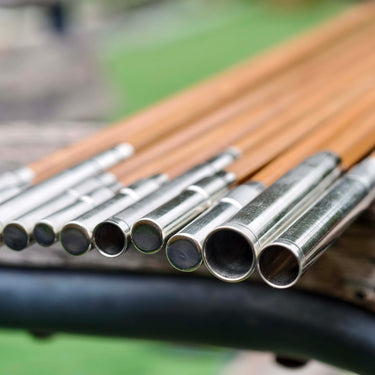
18% Nickel-Silver Ferrules
Garrison himself was particular about ferrules. He believed a poorly fitted ferrule — one that created stiffness discontinuity at the joint — was worse than no ferrule at all. His own ferrules were precision-fitted by hand, with tolerances measured in tenths of a thousandth.
We use 18% nickel-silver alloy ferrules, the same specification as Garrison's original work. Nickel-silver at this composition offers:
- Hardness sufficient to resist deformation through repeated assembly and disassembly (30,000+ cycles without measurable wear)
- Natural spring tension that holds the fit without play, even as humidity and temperature change
- Acoustic properties that preserve the rod's vibration characteristics — unlike brass or chrome-plated brass, which damp the tone
Each ferrule is hand-lapped to the individual blank section using a drawplate and micrometer. The tolerance target is 0.0005 inches of interference fit — perceptible as a single, audible click as the sections seat.
Construction Methodology
Our 212E is built in the traditional 6-strip hexagonal geometry, with strips split from individual culm quadrants and matched for consistent power fiber alignment. The planing form is set according to Garrison's published taper table, with the full knowledge that Garrison himself worked to tolerances that most modern makers find difficult to replicate consistently.
Assembly sequence:
- Strip selection and matching (2-3 days)
- Node preparation and straightening (1 day)
- Rough planing to within 0.020 inches of target (1-2 days)
- Final planing to within 0.002 inches (2-3 days)
- Heat treating for moisture stabilization (48 hours at 250°F)
- Gluing with urea-formaldehyde adhesive (Garrison's own choice)
- Drying and initial straightening (1 week)
- Ferrule fitting and final straightening (2-3 days)
- Guide wrapping with Grade A silk thread
- Multiple coats of phenolic-base varnish, hand-rubbed between coats (3-4 weeks total)
Total production time: approximately 8 weeks.
This is not a production schedule that allows shortcuts.
Casting the 212E: What to Expect
A first cast on a 212E is often described as surprising. Anglers accustomed to fast graphite may find it initially slow-feeling — the rod loads deeper and the timing window is longer. Within an hour, most experienced fly fishers have adapted, and the advantages become obvious.
At short range (20-35 feet): The 212E is patient. Short presentations with dry flies land with extraordinary delicacy — the progressive tip absorbs the final turnover with feather weight. Roll casts at short range are effortless.
At medium range (40-55 feet): This is where the 212E truly opens up. The full blank comes into play, and line speeds increase sharply. Tight loops become available without conscious hauling. The rod's natural casting arc is wide by fast-action standards — perhaps 70-80 degrees — but the line speed it generates within that arc is impressive.
At long range (60+ feet): The 212E's butt section provides real authority. With a single haul and proper timing, 70+ feet is within reach. This is unusual for bamboo, and it reflects Garrison's engineering: the 212E was not designed as a delicate creek rod, but as a large-river tool.
In wind: The power E designation is relevant here. The 212E's progressive load means more energy stored in the cast — and more energy available for cutting through a headwind or bending a crosswind presentation. It is one of the more wind-capable bamboo tapers in the 6-weight class.
Pairing Recommendations
Reel
A classic click-pawl reel in the 6-weight range complements the 212E's character. Consider:
- Hardy Marquis #6 or similar — the audible click matches the rod's ethos perfectly
- Orvis CFO III — lighter than the Hardy, good for long casting days
- ZHUSROD's own fly reels — machined aluminum with click-pawl mechanism, designed to balance our 8ft rods at the cork grip
Line
- DT6F (Double Taper) — the traditional choice, and still optimal. The progressive action reads a double taper's weight distribution better than a weight-forward
- WF6F — acceptable for large river work where distance is paramount; choose a head-length of 38+ feet for best feel
- Silk lines: If you fish silk, the 212E reveals dimensions of casting feel that modern synthetics obscure entirely
Leader
10-12 foot hand-tied tapered leader in 4X or 5X. The 212E's turnover power handles longer leaders without difficulty. For large dries on big water, a 14-foot leader landing quietly is entirely achievable.
The 212E in Context: Where It Fits the ZHUSROD Collection
The 212E occupies a specific role in our taper library. It is not the most delicate rod we offer — that designation belongs to tapers like the Leonard 50DF or Paul Young Perfectionist. Nor is it the most powerful — our Para 11 and Hardy Special serve that role.
What the 212E offers is maximum versatility within the premium category. A single rod that fishes competently across four fishing modes, handles large water without apology, and remains refined enough for a spring creek at evening.
It is the rod we recommend when an angler says: "I want one bamboo rod that can do everything."
→ Shop the Garrison 212E Taper at ZHUSROD
Frequently Asked Questions
Q: Is the Garrison 212E appropriate for a bamboo fly rod beginner?
A: The 212E rewards anglers who have developed timing and casting form. We generally recommend starting on a medium-action rod (such as the Paul Young Perfectionist or Dickerson 7012) before moving to the 212E. That said, a patient beginner who is willing to slow down their casting stroke will find the 212E teaches excellent habits.
Q: How does the 212E compare to the original 212?
The 212E is the Extended variant — slightly more backbone in the lower mid-section, translating to a bit more reserve power on long casts and in wind. For most fishing scenarios, the difference is subtle. The 212E was Garrison's preferred version in his later years.
Q: What is the lead time for a custom ZHUSROD 212E?
Current production time is approximately 8 weeks from order confirmation. We do not maintain finished inventory — each rod is built to order.
Q: Can I order the 212E as a blank only?
Yes. ZHUSROD offers the 212E in finished rod format (with guides, cork, reel seat) and as a raw blank for rodmakers who wish to complete their own build. Blank pricing and specifications are available on the product page.